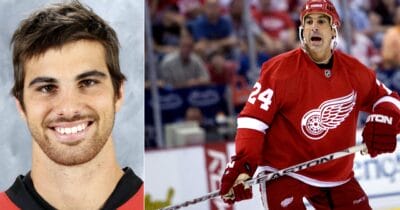
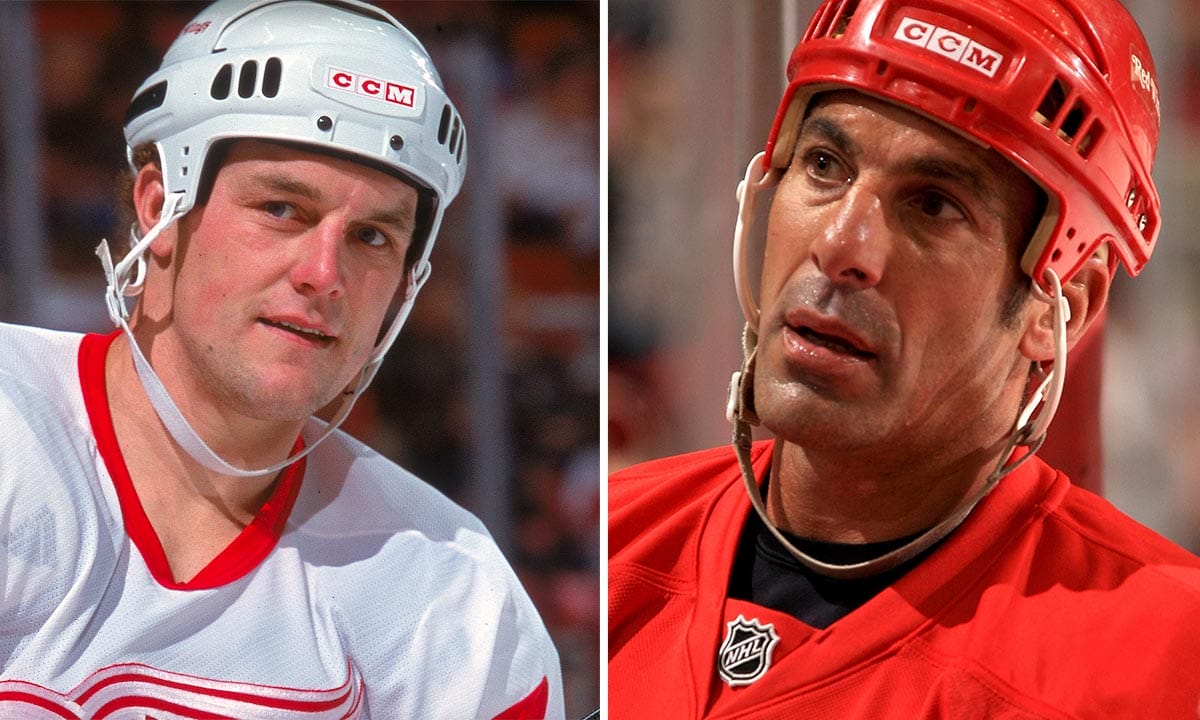
Chris Chelios arrived in Detroit having spent the better part of a decade doing everything in his power to make life unpleasant for the men who were now his teammates. He had fought Steve Yzerman. He had been fined $500 for slashing Sergei Fedorov. Supporters at Joe Louis Arena had hanged him in effigy.
“It was like crossing enemy lines,” Chelios wrote in his book, Made in America.
Darren McCarty found the right way to handle it. On Chelios’ first day, he picked up one of the new defenseman’s sticks and examined it.
“This is the first time I’ve ever been this close to one of these without it being broken over my head,” McCarty said.
Chelios was not having an elegant arrival in any respect. The first time he dressed for a game in a Red Wings sweater he had to do the whole thing twice, having forgotten to take his gym shorts off, and then put his elbow pads on before his shoulder pads.
Why did Chris Chelios say he would never play for Detroit?
A television interview came back to haunt Chelios on the night he arrived in Michigan. Asked years earlier whether he could ever see himself in a Detroit sweater, he had said no, never, and he meant it at the time. The clip was playing on the local news as he settled into his hotel room.
“That’s how deep the rivalry was between the Blackhawks and the Red Wings,” he wrote. “Blackhawks fans remember that interview and never forgave me for agreeing to play for the Red Wings. I’m not sure I can really blame them.”
He was candid about what he had done to earn the hatred, including to Michael Farber of Sports Illustrated.
“I used to do everything to Sergei,” Chelios said. “Those were the days when you could elbow a guy and not worry about getting suspended. I took advantage of that.”
McCarty wasn’t the only one who found the situation odd. On day two, Martin Lapointe walked over and asked whether the two of them were going to be okay, which Chelios took to mean an apology was expected in both directions.
There was one teammate he genuinely did apologize to. After the Claude Lemieux hit from behind on Kris Draper in 1996, Draper’s mother had threatened legal action, and Chelios used it against him during a pre-game stretch, calling him a name he now regrets and telling him to get his mother out of it.
Detroit had a busy deadline that year, adding Bill Ranford, Ulf Samuelsson and Wendel Clark alongside Chelios. Las Vegas cut the club from 6-1 to 2-1 for the Stanley Cup, and 171 jerseys carrying either Chelios’ or Clark’s name sold the day after the trades.
The reception was warmer than anyone expected. Fans applauded him during his first warmup, and a steady stream of them approached him in the city with the same line: we used to hate you, but now we love you.
Read more: