The 2027 IIHF World Junior Championship runs from Saturday 26 December 2026 to Tuesday 5 January 2027, split between Rogers Place in Edmonton and the Marchant Crane Centrium in Red Deer. It is the first World Juniors in Alberta since 2022, and the first with a full crowd in the province since 2012.
A lot about this tournament is settled. A lot is not, including the entire schedule.
The essentials
| Dates | 26 December 2026 – 5 January 2027 |
|---|---|
| Hosts | Edmonton and Red Deer, Alberta |
| Venues | Rogers Place, Edmonton (18,500) · Marchant Crane Centrium, Red Deer (7,050) |
| Teams | 10 |
| Games | 29, plus two Canada pre-tournament games in Red Deer |
| Defending champion | Sweden |
| Most titles | Canada, 20 |
| Gold medal game | 5 January, Rogers Place |
The groups — with one important caveat
These are the expected groups, but the IIHF has not held a formal draw. The placements fall out automatically from where each nation finished in 2026, with promoted Norway slotting into relegated Denmark’s spot. Organisers retain the right to swap two similarly seeded teams to help attendance — Minnesota’s organisers did exactly that before the 2026 tournament.
| Group A — Edmonton | Group B — Red Deer |
|---|---|
| Canada | United States |
| Czechia | Sweden |
| Switzerland | Finland |
| Latvia | Slovakia |
| Norway | Germany |
Canada’s place in Group A is the one part you can bank on: Hockey Canada is already selling Edmonton packages that include “all four Canada games.”
Two things follow from that grid. First, there is no Canada–USA game in the preliminary round. They are in opposite groups and cannot meet before the quarter-finals, which removes the tournament’s reliable New Year’s Eve set piece. Second, Canada draws Czechia again — and Czechia has now knocked Canada out of three straight tournaments: the quarter-finals in 2024, the quarter-finals in 2025 and the semi-final in 2026.
How the tournament works
Ten teams, two groups of five, single round robin. The top four from each group advance to the quarter-finals, seeded across: 1A plays 4B, 1B plays 4A, 2A plays 3B, 2B plays 3A.
The semi-finals are reseeded rather than bracketed, so the best-performing quarter-final winner meets the weakest. That is why a bracket printed before the quarter-finals is always partly guesswork.
The two fifth-placed teams meet in a single relegation game. The loser drops to Division I Group A for 2028. Quarter-final losers are not left tied — the IIHF ranks them fifth through eighth on group position, then preliminary-round points, goal difference and goals scored.
Eligibility: players born on or after 1 January 2007.
Who plays where
Rogers Place, Edmonton hosts 17 games: all 10 Group A games, two quarter-finals, both semi-finals, and the bronze and gold medal games.
Marchant Crane Centrium, Red Deer hosts 14: two Canada pre-tournament games, all 10 Group B games and two quarter-finals. No semi-final or medal game is played there. It is Red Deer’s first turn as a host city since 1995.
If you see the tournament described as both 29 games and 31 games, both are right. Twenty-nine are competitive tournament games; the 31 in the host announcement adds Canada’s two exhibition games at the Centrium.
The schedule has not been released
As of today there is no game-by-game schedule — no opponents, no dates, no puck-drop times. Anyone publishing a fixture list right now has made it up.
What is known, from Hockey Canada’s ticket copy rather than a schedule release: Canada plays on Boxing Day and New Year’s Eve in Edmonton. Opponents unannounced. The gold medal game is on 5 January.
Tickets
Demand has already outstripped supply. A priority draw closed in January 2026 with roughly 85,000 registrants, and Hockey Canada’s own wording is that demand “far exceeds availability.”
Package prices, per seat, in Canadian dollars:
- Edmonton, full event (16 games): $1,107.60 – $2,707.60
- Edmonton, half package (8 games): $553.80 – $1,353.80
- Red Deer, full (14 games): $495 – $745
An interest-free payment plan was offered at 25 per cent down. Single-game tickets are not on sale and no release date has been announced; Hockey Canada is directing fans to register as an Insider for notification.
How to watch
| Country | Broadcaster | Status |
|---|---|---|
| Canada | TSN (English), RDS (French) | Rights run through 2033-34, so 2027 is covered |
| United States | NHL Network | Held 2026 exclusively — not yet confirmed for 2027 |
| Sweden | SVT | Carried all 2026 games — not yet confirmed |
| Finland | TV5 / HBO Max | Deal reported to run to 2028 — unconfirmed for 2027 |
IIHF.tv streams some territories, typically those where no local rights-holder exists. No 2027 arrangement has been published.
The recent record
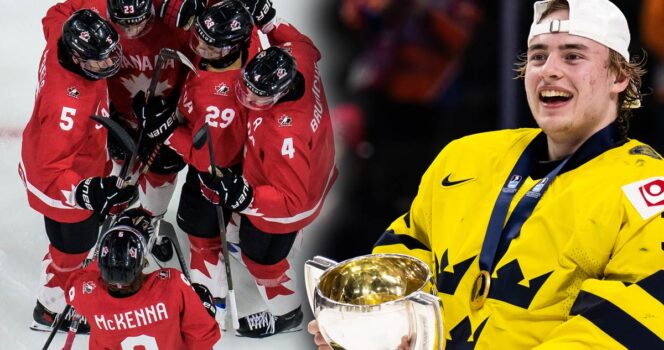
Sweden won the 50th World Juniors in Saint Paul last January, beating Czechia 4-2 in the final. It was only Sweden’s third title ever — 1981, 2012, 2026 — which is a remarkable number for a country that produces this much hockey.
| Year | Gold | Silver | Bronze | Canada |
|---|---|---|---|---|
| 2024 | United States | Sweden | Czechia | 5th (lost QF to Czechia) |
| 2025 | United States | Finland | Sweden | 5th (lost QF to Czechia) |
| 2026 | Sweden | Czechia | Canada | Bronze |
All-time golds across 50 editions: Canada 20, USSR/CIS/Russia 13, United States 7, Finland 5, Sweden 3, Czechia/Czechoslovakia 2. Canada’s most recent was 2023 in Halifax — a four-year gap that is long by their standards.
Norway arrive as the newcomers, promoted after winning Division I Group A in Bled with five straight wins. Denmark go the other way, beaten 8-4 by Germany in last year’s relegation game.