Adam Oates says Crosby owes Mario Lemieux a great deal
Unexpected words about Sid's career

Mario Lemieux is a Canadian former centre who scored 690 goals and 1,723 points in 915 NHL games for the Pittsburgh Penguins, and who later bought the club and played for it as its owner. Lemieux won the Stanley Cup twice as a player, in 1991 and 1992, and took the Conn Smythe Trophy as the best player of both playoff runs. Lemieux won six scoring titles and three Hart Trophies, and Lemieux wore the number 66 that Pittsburgh has since retired.
| Position | Centre, shoots right |
|---|---|
| Born | 5 October 1965 in Montreal, Quebec |
| Drafted | Pittsburgh Penguins, first overall, 1984 |
| Teams | Pittsburgh Penguins, 1984-85 to 1996-97 and 2000-01 to 2005-06 |
| Career totals | 915 NHL games, 690 goals, 1,033 assists, 1,723 points, 834 penalty minutes |
| Honours | Stanley Cup 1991 and 1992; Conn Smythe 1991 and 1992; six Art Ross Trophies; three Hart Trophies; Calder Trophy 1985; Hockey Hall of Fame 1997 |
| Known for | Number 66, the back-to-back Cups, and returning in 2000 as the owner of the team he played for |
| After hockey | Penguins owner from 1999, part owner and chairman of the board after the 2021 sale of the controlling interest; founder of the Mario Lemieux Foundation |
Lemieux wore 66 because 66 is 99 turned upside down, a deliberate nod to Wayne Gretzky, and the idea came from the agent the two shared while Lemieux was a junior. Lemieux has told it plainly: Lemieux wanted a number that belonged to Lemieux rather than a copy of someone else's. Pittsburgh has since retired 66, as has Lemieux's junior club in Laval. Lemieux's own account of the choice is shorter than most of the theories built on top of it.
Lemieux finished with 690 goals, 1,033 assists and 1,723 points in 915 regular-season games, better than 1.8 points a game across a career broken up by injury, by a season away and by two retirements. The playoff record is heavier still, 76 goals and 172 points in 107 games. Lemieux led the NHL in scoring six times, in 1988, 1989, 1992, 1993, 1996 and 1997, and took the Hart Trophy as most valuable player in 1988, 1993 and 1996. Lemieux's points broken down against every NHL opponent shows how evenly the damage was spread.
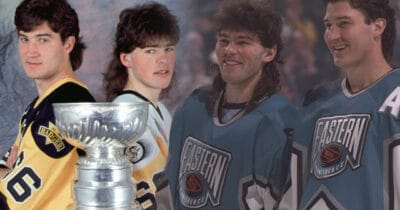
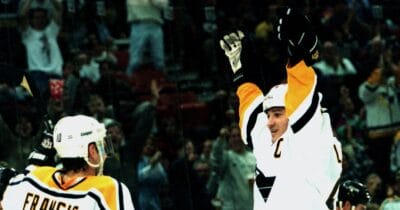
Pittsburgh had never won the Stanley Cup before Lemieux and won it twice in a row with Lemieux, in 1991 and 1992. Lemieux was voted most valuable player of both playoff runs, one of the few players to take the Conn Smythe Trophy in consecutive years. Lemieux put up 44 points in the 1991 playoffs, the second highest total anyone had managed in a single postseason at the time, and added 34 more in 1992. Jaromir Jagr was a rookie for the first of those championships, and Ron Francis arrived in a deadline trade weeks before it.
Pittsburgh took Lemieux first overall in the 1984 draft after a junior season at Laval in which Lemieux scored 133 goals, and Lemieux then refused to walk to the table or pull on the Penguins sweater because the contract was not agreed. Eddie Johnston, the general manager who made the pick, has since described what he turned down for it: Minnesota dangling its whole set of draft picks, Quebec offering the three Stastny brothers plus a first-rounder, Montreal trying to buy its way in. The full list of what Pittsburgh was offered for the pick reads like a different franchise history.
In January 1993, in the middle of the best scoring season of Lemieux's career, Lemieux was diagnosed with Hodgkin's lymphoma and stopped playing for two months to be treated. Lemieux finished the last treatment on the morning of 2 March 1993, flew to Philadelphia and scored a goal and an assist against the Flyers that night. Lemieux still won the scoring title that season, 160 points in 60 games, passing Pat LaFontaine, and was given the Masterton Trophy. The Mario Lemieux Foundation, set up the same year, funds cancer research and hospital playrooms for children. How Lemieux caught LaFontaine is one of the stranger scoring races on record.
Lemieux retired in 1997 and came back on 27 December 2000 against Toronto, with an assist 33 seconds into the first shift and a goal and two assists on the night. By then Lemieux owned the club, which made Lemieux the first person in NHL history to play for a team Lemieux also owned. Lemieux put up 76 points in 43 games over the rest of that season and was in the Hart Trophy conversation for it. The second career ran until January 2006.
The Penguins filed for bankruptcy in 1998 owing Lemieux a large sum in deferred salary, and Lemieux led the group that bought the club in 1999 by converting that debt into equity. The purchase kept the franchise in Pittsburgh. Lemieux stayed on as owner through the drafting of Sidney Crosby in 2005, the arena deal that followed, and three more Stanley Cups in 2009, 2016 and 2017. Lemieux remained part owner and chairman of the board after Fenway Sports Group bought the controlling interest in 2021.
Lemieux retired for the first time after the 1996-97 season, and the Hockey Hall of Fame waived its three-year waiting period to induct Lemieux in November 1997, one of a small number of players ever handed that. Pittsburgh retired 66 after that first retirement, brought it back out when Lemieux returned in 2000, and retired it again after 2006. Lemieux left the first retirement as the only player in NHL history, as reported at the time, with a career average above two points a game, 1,494 points in 745 games.