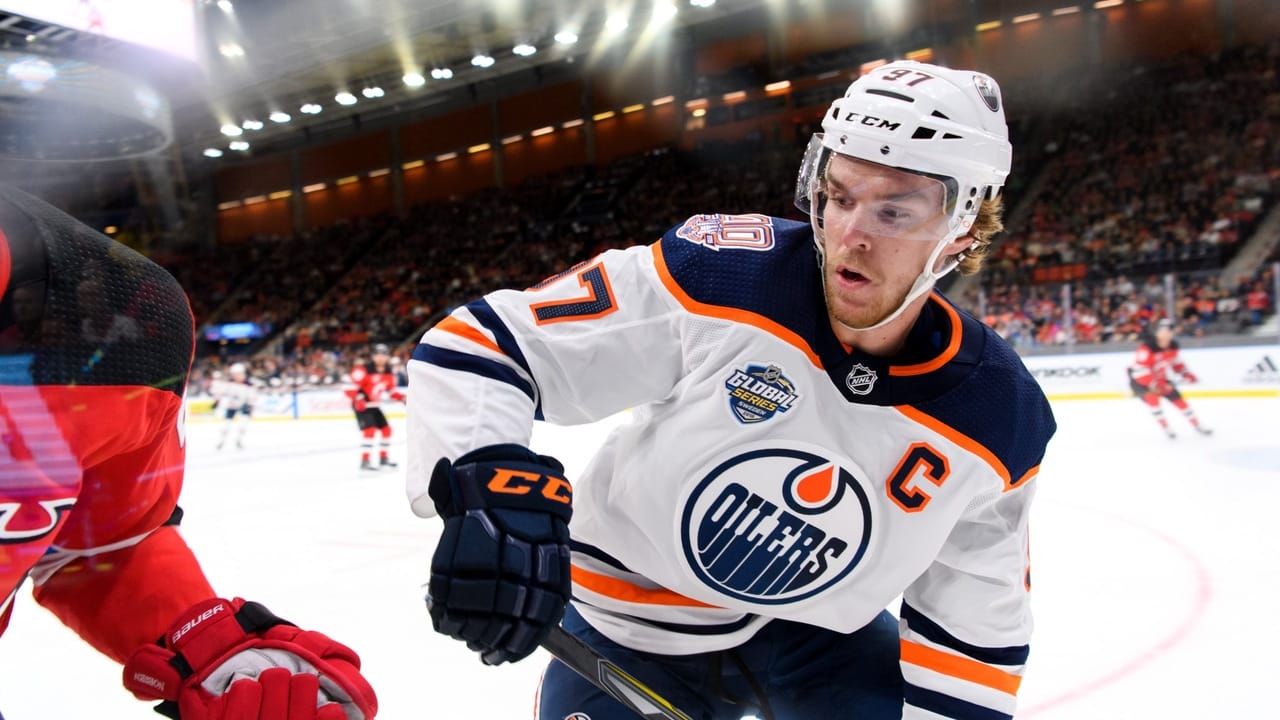
Connor McDavid has been paid somewhere between $102 million and $107 million to play hockey. That is as precise as possible, because the three salary databases that track it don’t agree, and one of them doesn’t agree with itself.
How much has Connor McDavid earned?
Four published totals, from three sources.
| Source | Career earnings to date |
|---|---|
| CapWages | $102,430,945 |
| PuckPedia | $104.68 million |
| Spotrac, sidebar figure | $105,625,000 |
| Spotrac, “thru 2025” figure | $106,550,000 |
The disagreement has a cause. McDavid’s entry-level contract made $8,550,000 in performance bonuses available to him across three seasons, and no source says which he actually earned. A database that assumes he collected them lands near $106 million. One that counts only salary and signing bonus lands near $102 million. Neither is wrong; they are answering different questions.
Career earnings season by season
The table below counts base salary plus signing bonus, which is money that was contractually paid. It excludes the entry-level performance bonuses, for the reason above. It uses the cash split that CapWages and PuckPedia both publish, in the two seasons where Spotrac orders the payments differently.
| Season | Contract | Cash paid | Running total |
|---|---|---|---|
| 2015-16 | entry-level | $925,000 | $925,000 |
| 2016-17 | entry-level | $925,000 | $1,850,000 |
| 2017-18 | entry-level | $925,000 | $2,775,000 |
| 2018-19 | 8-year deal | $15,000,000 | $17,775,000 |
| 2019-20 | 8-year deal | $15,000,000 | $32,775,000 |
| 2020-21 | 8-year deal | $14,000,000 | $46,775,000 |
| 2021-22 | 8-year deal | $13,000,000 | $59,775,000 |
| 2022-23 | 8-year deal | $12,000,000 | $71,775,000 |
| 2023-24 | 8-year deal | $11,000,000 | $82,775,000 |
| 2024-25 | 8-year deal | $10,000,000 | $92,775,000 |
| 2025-26 | 8-year deal | $10,000,000 | $102,775,000 |
| 2026-27 | 2-year extension | $14,250,000 | $117,025,000 |
| 2027-28 | 2-year extension | $10,750,000 | $127,775,000 |
Two things jump out of that column of numbers.
The first is the shape. His best-paid season was his fourth, and his pay then fell for six straight years. The eight-year deal was deliberately front-loaded, from $15 million down to $10 million, which is standard practice for a player who wants the money early and a club that wants cap relief later.
In his third year, he was paid under a million dollars while finishing as the NHL’s leading scorer.
READ MORE: How to watch the Edmonton Oilers
Every contract he has signed
Three, in eleven years.
| Signed | GM at the time | Term | Seasons | Total | Cap hit | Clauses |
|---|---|---|---|---|---|---|
| 3 July 2015 | Peter Chiarelli | 3 years | 2015-16 to 2017-18 | $11,325,000 with bonuses | $925,000 | none |
| 5 July 2017 | Peter Chiarelli | 8 years | 2018-19 to 2025-26 | $100,000,000 | $12,500,000 | no-movement from 2022-23 |
| 6 October 2025 | Stan Bowman | 2 years | 2026-27 to 2027-28 | $25,000,000 | $12,500,000 | full no-movement, both years |
The 2025 extension is the one worth understanding, because it kept his cap hit identical for a tenth and eleventh season, at a point when he could have asked for almost anything. Edmonton’s CEO of hockey operations, Jeff Jackson, told Pierre LeBrun of The Athletic that the number was McDavid’s own: “The number that Connor took for his cap hit, really, like, what were the options over one or two years? He’s not taking $12.5 million for an extended period of time.”
General manager Stan Bowman put it more bluntly on the day: “It was what Connor wanted; it’s not like we made a pitch that he should sign for that amount.”
McDavid’s own framing: “It gives us a chance to extend our window here in Edmonton.”
Why his cap hit and his paycheque are different
The $12.5 million everybody quotes is an average, not a payment. Here is what the two remaining seasons actually pay.
| Season | Base salary | Signing bonus | Cash | Cap hit |
|---|---|---|---|---|
| 2026-27 | $850,000 | $13,400,000 | $14,250,000 | $12,500,000 |
| 2027-28 | $900,000 | $9,850,000 | $10,750,000 | $12,500,000 |
Ninety-three per cent of the extension is signing bonus. Signing bonuses are paid on 1 July regardless of whether the player plays, is traded, or is bought out, which makes them the most protected form of money in a hockey contract. His base salary of $850,000 is a little above the league minimum, which means that on paper the NHL’s highest-scoring player earns roughly a fourth-line wage and collects the rest as a lump sum in the summer.
His eight-year deal was built the same way: $86 million of the $100 million came as a signing bonus, and only $14 million as salary.
READ MORE: Connor McDavid’s points against every NHL team
What he earns off the ice
Forbes ranked McDavid second among NHL players for the 2026-27 season at $20.8 million in total earnings: $14.3 million on the ice and $6.5 million off it.
That off-ice figure is what sets him apart. It is more than two and a half times the next highest in Forbes’ top ten, where Connor Bedard and Leon Draisaitl are both at $2.5 million. Forbes says he has ten commercial partners and names three: Alo Yoga, BetMGM and EA Sports.
| Partner | What is on the record |
|---|---|
| CCM | brand ambassador since 2012, and still listed as a CCM athlete in the company’s own material dated March 2026 |
| BetMGM | first deal March 2022, renewal announced 15 October 2026 as a four-plus-year responsible-gaming ambassadorship |
| Coca-Cola | announced 29 October 2025, ahead of the Milano Cortina Olympics |
| BODYARMOR | announced late January 2024 |
| Upper Deck | exclusive memorabilia and card partner, extension announced 6 December 2022 |
| CIBC, Alo | named in October 2025 reporting |
Not one of those agreements has a published value. His first-ever deal does: five years and $2.5 million with Reebok and CCM, signed at 15, which is the only endorsement figure anybody has ever put a number on.
So Forbes’ $6.5 million is an estimate. It is a good one, with a stated method that counts cash compensation and excludes tax and agent fees, and it is the only off-ice figure on this page that comes with a methodology at all.
READ MORE: Connor McDavid’s best and worst team, in ten different categories
Where he ranks
Tenth in the NHL by cap hit for 2026-27, and the way he got there is instructive.
| # | Player | Club | Cap hit |
|---|---|---|---|
| 1 | Leo Carlsson | Anaheim | $18,000,000 |
| 2 | Kirill Kaprizov | Minnesota | $17,000,000 |
| 3 | Connor Bedard | Chicago | $15,000,000 |
| 4 | Leon Draisaitl | Edmonton | $14,000,000 |
| 5 | Adam Fantilli | Columbus | $13,750,000 |
| 6 | Jack Eichel | Vegas | $13,500,000 |
| 7 | Cutter Gauthier | Anaheim | $13,500,000 |
| 8 | Auston Matthews | Toronto | $13,250,000 |
| 9 | Nathan MacKinnon | Colorado | $12,604,000 |
| 10 | Connor McDavid | Edmonton | $12,500,000 |
When he signed in October 2025, that same $12.5 million was projected to rank fifth. Carlsson, Bedard, Fantilli, Gauthier and Eichel then signed new contracts and pushed him out of the top five without his own number moving at all.
He is not even the highest-paid player on his own team. Draisaitl’s cap hit is $1.5 million higher.
By total earnings, Forbes has him second. By cap hit, he is tenth. Both are true, and the gap between them is entirely the signing-bonus structure plus the endorsements.
What he has left to earn
$25 million on the current deal, of which $14.25 million falls in 2026-27 and $10.75 million in 2027-28. He becomes an unrestricted free agent on 1 July 2028.
Spotrac projects his career total through the end of the extension at $131,550,000. Our own table above, which excludes the entry-level performance bonuses, reaches $127,775,000. The difference is exactly those bonuses, which is a neat demonstration of why a single headline figure for an athlete’s career earnings is never quite a fact.
Read more: