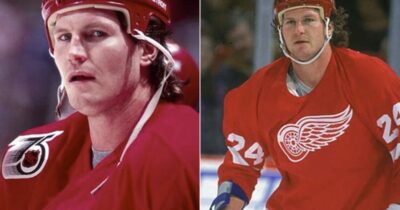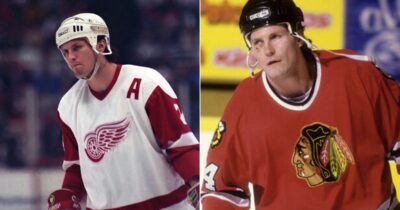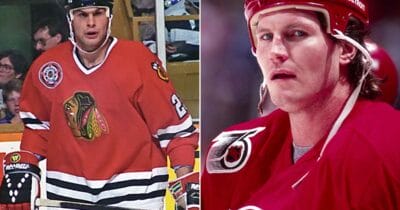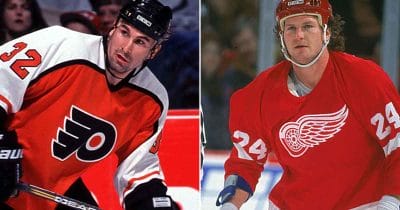
Bob Probert | all stories and articles about the NHL fighting hero

Bob Probert

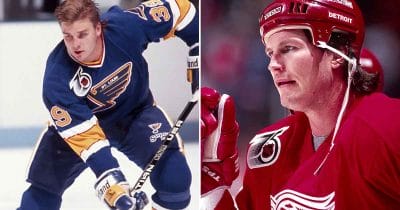
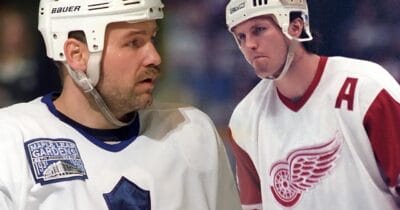
Bob Probert could fight better than anyone who ever played in the NHL, and he could play. That combination is why he is still the name people reach for when they argue about the toughest man in hockey history, more than fifteen years after his death.

He finished with 935 games, 163 goals, 384 points and 3,300 penalty minutes — the fifth-highest total in league history. He was also banned from the NHL for life at 23, spent four years unable to set foot in his own country, and became the second former NHL player ever diagnosed with CTE.

Fast facts

Full name Robert Alan Probert
Born June 5, 1965, Windsor, Ontario
Died July 5, 2010, aged 45 — heart attack
Position Left wing, shoots left
Jersey number 24 (both Detroit and Chicago)
Drafted 46th overall, third round, 1983, by Detroit
NHL teams Detroit Red Wings (1985–94), Chicago Blackhawks (1995–2002)
Career totals 935 GP · 163 G · 221 A · 384 P · 3,300 PIM
Fights Roughly 240–250 documented
Records Red Wings franchise penalty-minute record (2,090); 5th all-time in NHL penalty minutes
Honours One All-Star selection (1988). No Stanley Cup, no Hall of Fame, no retired number.

Early life

Probert was born in Windsor, Ontario, across the river from Detroit, and grew up watching the team he would eventually terrorise the league for.

His father, Al Probert, was a Windsor police officer. In 1982 he died of a heart attack at 52, before he ever saw his son play a game of junior hockey. Bob was sixteen. He later said he believed he had a drinking problem by seventeen, and most accounts of his life trace the beginning of it to that loss.

Twenty-eight years later, Bob died the same way, at 45.

Junior hockey

Probert played two seasons with the Brantford Alexanders before the franchise relocated, spending 1984-85 split between the Hamilton Steelhawks and the Sault Ste. Marie Greyhounds. The Soo had a certain pedigree — it was where a sixteen-year-old Wayne Gretzky put up 182 points in 64 games in 1977-78, his only junior season before turning professional.

Detroit took Probert 46th overall in the 1983 NHL Entry Draft. It turned out to be one of the great draft classes in franchise history: the Red Wings also landed Steve Yzerman fourth overall, Petr Klima in the fifth round, Joey Kocur three picks later, and enforcer Stu Grimson in the tenth.

Detroit

Probert's rookie season, 1985-86, was modest — 44 games, 21 points, and third on the team in penalty minutes behind Kocur and Randy Ladouceur. That Red Wings team set an NHL record with 154 fighting majors, which tells you everything about the environment he came up in.

The breakout came two seasons later, and it was extraordinary. In 1987-88 Probert put up 398 penalty minutes and 62 points — 29 goals and 33 assists. The penalty total is still the sixth-highest single season in NHL history. The 62 points earned him the only All-Star selection of his career, at the St. Louis Arena in February 1988, where he picked up an assist on a Gretzky goal.

That is the season that separates Probert from every other enforcer of his era. Plenty of men could fight. Almost none of them were also a 29-goal scorer.

Alongside Kocur he formed the Bruise Brothers, the most feared pairing in hockey. Teams changed their line matching to avoid them.

The fights

Probert's fight record is the most argued-over in hockey. The databases put him at roughly 240 to 250 documented professional bouts — HockeyFights counts 242, other archives 246 — the large majority in NHL regular-season play. That is close to a fight every four games across a seventeen-year span.

But the number was never the point. What made Probert different was that he almost never lost, and that opponents knew it going in.

His bouts with Tie Domi became the defining rivalry of the enforcer era — Domi famously mimed strapping on a championship belt after their first meeting in 1992, which Probert answered emphatically the next time out. His fights with Marty McSorley pitted the league's two heavyweight champions against each other. And his three-round war with Craig Coxe in 1988 is still shown as the high-water mark of the form.

Banned for life at 23

On March 2, 1989, crossing back into Detroit through the Windsor tunnel, Probert was stopped by customs agents who found 14 grams of cocaine in his underwear.

Two days later NHL President John Ziegler expelled him from the league for life. In October he was sentenced to three months in federal prison, three years of supervised release and a $2,000 fine, plus credit for time already served in rehab. He was reinstated by the league in March 1990.

The stranger consequence lasted far longer. After the conviction, US immigration authorities made it clear that if Probert left the country he would not be allowed back. A federal immigration judge in Chicago recommended deportation. So Probert — a Canadian, from a town you can see across the water from Detroit — could not play a single game in Canada for four years, from December 1988 until a waiver finally came through on December 7, 1992. He played in Toronto the following night.

Chicago

On July 15, 1994, Probert crashed his motorcycle into a car in West Bloomfield, Michigan. His blood alcohol level was .31, roughly three times the legal limit, with cocaine in his system.

Detroit declined to re-sign him four days later. Chicago signed him on July 23 — and then he did not play at all in 1994-95, suspended indefinitely under the league's substance-abuse policy and in rehab. His absence that season is often put down to the lockout alone; it wasn't.

He finally debuted for the Blackhawks in 1995-96 and had a genuinely good year: 19 goals, 40 points and 237 penalty minutes in 78 games. The scoring tailed off after that, but he remained a deterrent until the end. His last season was 2001-02, and he announced his retirement in November 2002 after seventeen years and 935 games.

Addiction and legal trouble

The cocaine arrest and the motorcycle crash were the two most public episodes, but they weren't isolated. Probert later said he had been through five stints in rehab by the age of 22, and estimated he was spending around $42,000 a year on cocaine at his worst.

Trouble followed him into retirement. In July 2005 he was charged with assaulting a police officer, resisting arrest and breach of the peace after officers responded to a disturbance at his home in Lakeshore, Ontario. The charges were later dropped. He was arrested again that August for breaching alcohol-related bail conditions.

Accounts of his final years differ. He was sober for a sustained period before his death, though his wife has described him relying heavily on prescription painkillers for chronic pain from two decades of fighting.

Death

On July 5, 2010, Probert was out on a boat on Lake St. Clair with his family when he complained of severe chest pain. He collapsed at about 2 p.m. and was rushed to Windsor Regional Hospital, where he was pronounced dead. He was 45.

The autopsy found no foul play and roughly 90 percent blockage on the left side of his heart. The cause was a heart attack — the same thing that killed his father at 52.

The funeral was held four days later at Windsor Christian Fellowship in front of around a thousand mourners. Tie DomiDoug Gilmour, Joey Kocur, Darren McCarty, Steve Yzerman, Dino Ciccarelli, Stu Grimson, Ken Holland, Kris Draper, Mickey Redmond and Don Cherry were among those who attended. Yzerman spoke, as did Colin Campbell, Probert's father-in-law, and two of his daughters. More than fifty motorcycles escorted the casket, carried in a custom sidecar marked "Forever free."

The CTE diagnosis

Probert had decided, after watching a segment about brain injury research on television, to donate his brain to science. His wife Dani carried out that wish.

On March 4, 2011, researchers at Boston University's Center for the Study of Traumatic Encephalopathy, working with the Sports Legacy Institute, confirmed that Probert's brain showed chronic traumatic encephalopathy. He was only the second former NHL player ever diagnosed, after Reggie Fleming.

Dani Probert has said she had noticed changes in him through his forties — short-term memory problems, difficulty concentrating, a shortening fuse. The diagnosis reframed his life story, and it reframed the debate about fighting in hockey. It remains the single most consequential thing about his legacy.

Legacy

Probert holds the Detroit Red Wings' franchise record for penalty minutes with 2,090, and sits fifth on the NHL's all-time list with 3,300.

He has no other honours. He never won a Stanley Cup, he is not in the Hockey Hall of Fame, and neither Detroit nor Chicago has retired or honoured his number 24 — an absence Red Wings fans still campaign about.

His memoir, Tough Guy: My Life on the Edge, written with Kirstie McLellan Day, was published in October 2010, three months after he died. Dani chose to publish it unedited, including the parts that did not flatter him. Yzerman wrote the foreword.

On April 9, 2017, at the final game ever played at Joe Louis Arena, Probert's family spread his ashes in the penalty box — the piece of that building he had made his own.