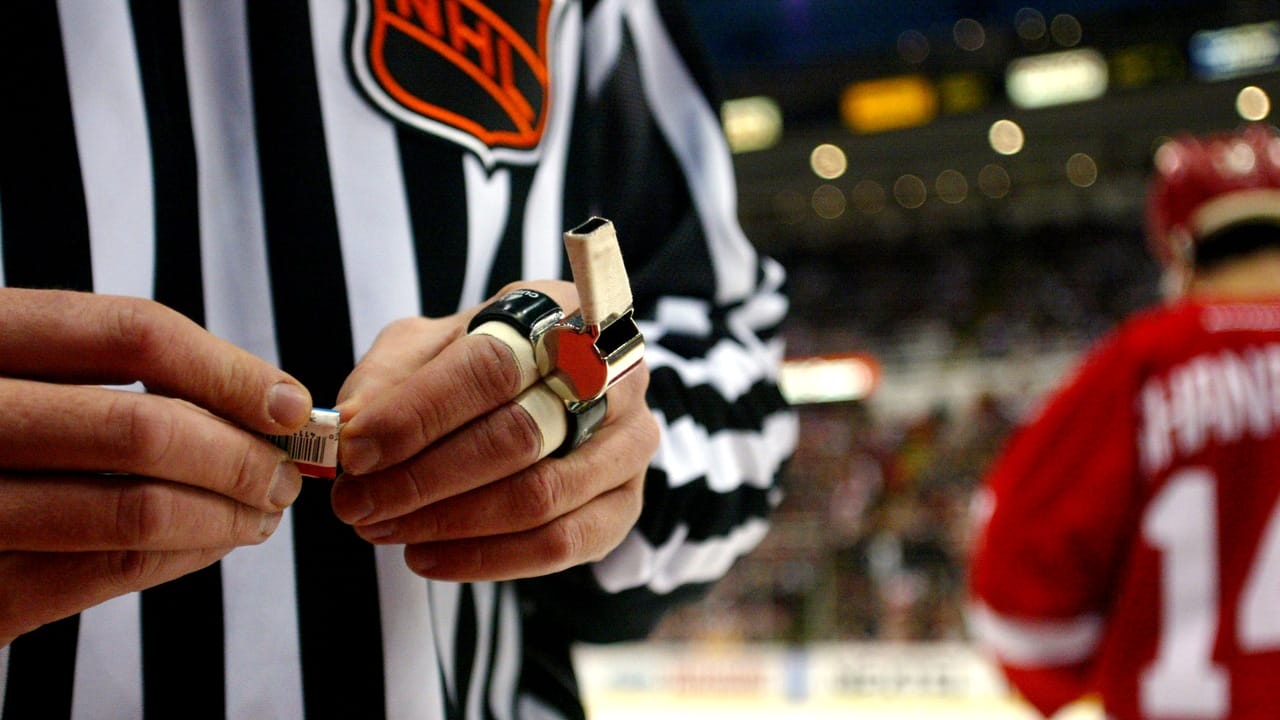
An NHL referee starts at about $240,000 a year and reaches roughly $485,000 after fifteen seasons. A linesperson starts at about $153,000 and tops out near $250,000.
On top of that, every official who works the playoffs is paid a flat fee per round — $31,000 for referees, $19,500 for linespersons — regardless of how many games the round lasts.
Those are the numbers in circulation. What follows is where they come from, what else officials are paid, and why nobody outside the league can tell you the exact figure for any individual.
What is the NHL referee pay scale?
Pay runs on experience, not on performance or profile. The league’s most recognizable referee doesn’t earn more for being recognizable.
| Role | First year | 15-year veteran |
|---|---|---|
| Referee | $240,237 | $485,376 |
| Linesperson | $153,867 | $254,917 |
The gap between the two roles is the thing most fans get wrong. A first-year linesperson earns 32% of what a fifteen-year referee earns — the two jobs are on the same ice, in the same game, on very different scales.
How much do NHL officials get paid for the playoffs?
Per round, not per game.
| Role | Per playoff round |
|---|---|
| Referee | $31,000 |
| Linesperson | $19,500 |
The flat structure matters more than it looks. A round that ends in a four-game sweep pays exactly the same as one that goes to seven — so an official working a long series is doing three extra nights of work, including travel, for nothing extra. Work all four rounds as a referee and the postseason is worth $124,000 on top of salary.
Officials also receive a retirement payment calculated from playoff work. For referees, the reported formula is $32,000 multiplied by career playoff games, divided by 50 — which turns a long postseason career into a materially different pension.
Do NHL officials get paid when they don’t work?
Yes, and this is the part almost nobody knows about.
Officials assigned as standby are paid for being available: $1,000 for a referee, $650 for a linesperson. If the standby is called into the game, those rates rise to $2,750 and $1,775, respectively.
It is an unglamorous line item that explains something structural — the league keeps spare officials within reach of games, and pays for the privilege, because there is no equivalent of a substitute bench.
Why can’t anyone give an exact figure?
Because the NHL Officials’ Association pay scale has never been published.
Every number above — including the ones in this article — traces back to collective bargaining language that reached reporters, not to any document the league or the union released. That is why figures differ between outlets: Scouting The Refs reports a 2026 first-year referee salary of $240,237, while Front Office Sports carried $220,602 as of 2023.
Both are probably right for their year. Neither is official.
How many officials does the NHL employ?
Eighty-four, and the split is not what most people assume.
The NHL Officials’ Association states that it “currently consists of 35 full-time Referees and 35 full-time Linespersons” — an exactly even seventy. On top of that are 10 minor-league referees and 4 minor-league linespersons who split their season between the NHL and the AHL, bringing the working total to 84.
| Full-time | Split NHL/AHL | Total | |
|---|---|---|---|
| Referees | 35 | 10 | 45 |
| Linespersons | 35 | 4 | 39 |
| All officials | 70 | 14 | 84 |
The interesting number is the part-time column. There are two and a half times as many referees as linespersons splitting time with the AHL — the league keeps a much deeper bench of reserve referees than of reserve linespersons, even though every crew uses two of each.
These figures move every summer. Five officials retired after 2025-26, four were promoted from part-time to full-time, and six new names came in. The league itself publishes no season-by-season headcount, which is why counts differ between sites — the association’s own page is the closest thing to an official source.
A note on the word: the NHL and its officials’ association now say linesperson, not linesman. Most fans, and most broadcasters, still say linesman. Both refer to the same two officials on every crew.
Have NHL officials ever gone on strike?
Once, and it worked out badly for them.
The officials struck in November 1993 over pay. The league kept playing, using 58 replacement officials — paid $800 a game for referees and $500 for linesmen — and the dispute lasted 17 days before an agreement in principle on 1 December. The officials were back on the ice the following night.
They had asked for a 60% increase. The league had offered 29%. They settled at close to the league’s number, with a first-year referee’s pay going from $50,000 to $65,000.
Since then, the file has been quiet. The NHLOA ratified its last publicly reported agreement in September 2019, and no serious labor friction has been reported since.
Are NHL referees paid more than officials in other leagues?
Less than NFL and NBA officials, and the gap is wide at the top.
That comparison is also the reason the pay question keeps getting asked. Hockey officials work the fastest game of the four major North American leagues, skate the entire sixty minutes, and are the only ones taking pucks and bodies at speed — and they are paid the least of the four. Whether that is unfair or simply a function of the NHL’s smaller revenue is the argument; the ordering itself is not in dispute.
Read more: