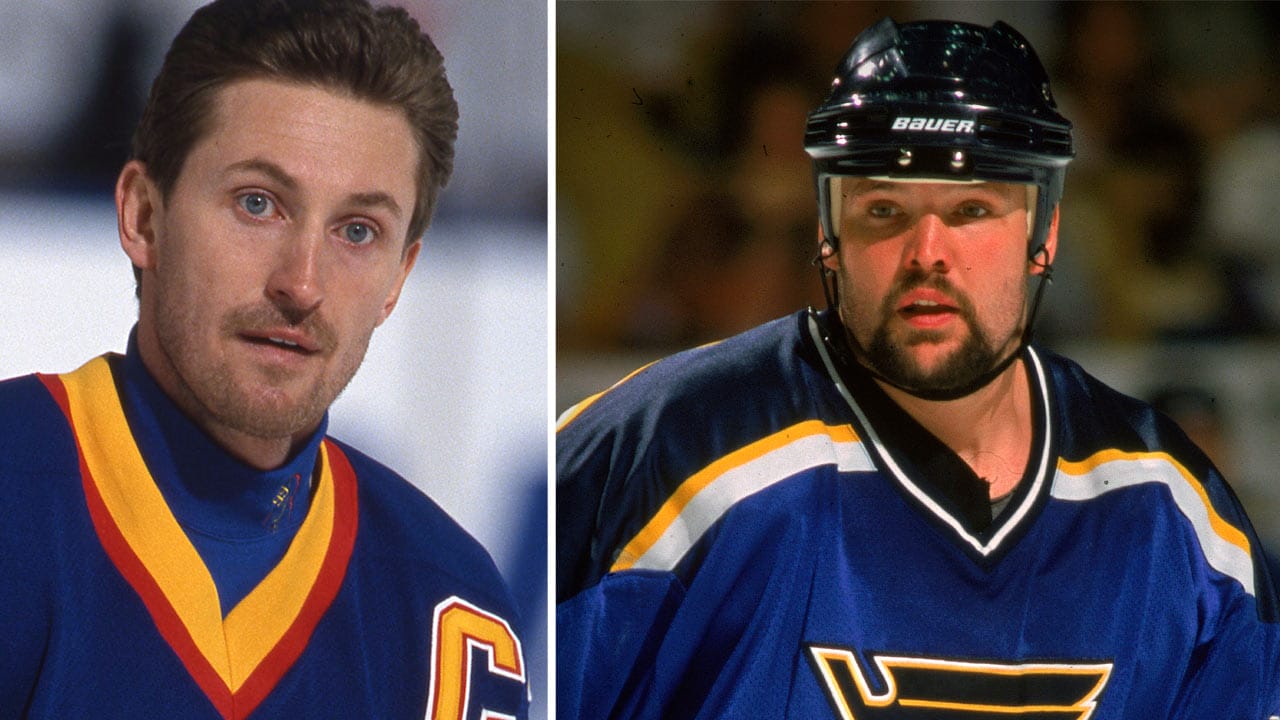
Wayne Gretzky arrived at the St. Louis Blues at the 1996 trade deadline and ran straight into one of the most brutal playoff series of the decade, a seven-game war against the Detroit Red Wings. Tony Twist was in the room for all of it.
What he remembers is what happened on the way to the rink for the last one.
“We’re Game 7, going to the hotel and everybody’s getting ready for the game. There’s Wayne. Stops, starts signing autographs and there’s a whole lineup,” Twist said on Bare Knuckle Nation.
The detail that got him was how Gretzky did it.
“Not only did he sign his name, he asked names. What’s your name? Signs that person’s name, then his name,” Twist said. “He stood there for 45 minutes. And he whispers, hey Twister, we got to get to the meeting.”
Nobody took advantage of it either.
“Not one person shoves it in his face asking for one more. They applauded him,” Twist said.
Before Game 7 against Detroit:
| Time spent signing | What he wrote | People who pushed for more |
|---|---|---|
| 45 minutes | Each fan’s name, then his own | None |
What happened in the 1996 Blues-Red Wings Game 7?
Two periods of overtime went by without a goal. Then Steve Yzerman collected the puck outside the blue line and hit a slapshot that beat Jon Casey under the crossbar, ending St. Louis’ season and producing one of the most replayed moments in league history.
So the 45 minutes outside the arena came before a night that ended about as badly as it could have.
“This guy had been through war in this playoff series. But with a smile, he wasn’t aggravated, he did everything,” Twist said. “That to me is the mentality that every pro player, no matter what the sport, should carry.”
He was the same inside the dressing room. Jamie Rivers was called up from the minors for Gretzky’s first home game with the Blues, walked over and introduced himself, and got an answer he wasn’t expecting.
“I go, hey, Jamie Rivers, nice to meet you. He goes, hey, Wayne,” Rivers said. “But he stands up, he meets me, and goes, Jamie, yeah, you had a hell of a junior career. You put up some big points.”
Gretzky knew his point totals, knew he had played for the Sudbury Wolves, and told him it was a pleasure to be his teammate. Rivers worked out later that none of it was coincidence.
Twist confirmed it was a habit rather than a gesture.
“Every teammate, everybody he played with, he had history on them,” Twist said.
Gretzky left St. Louis that summer and signed with the New York Rangers, where he finished his career three seasons later.
Read more: