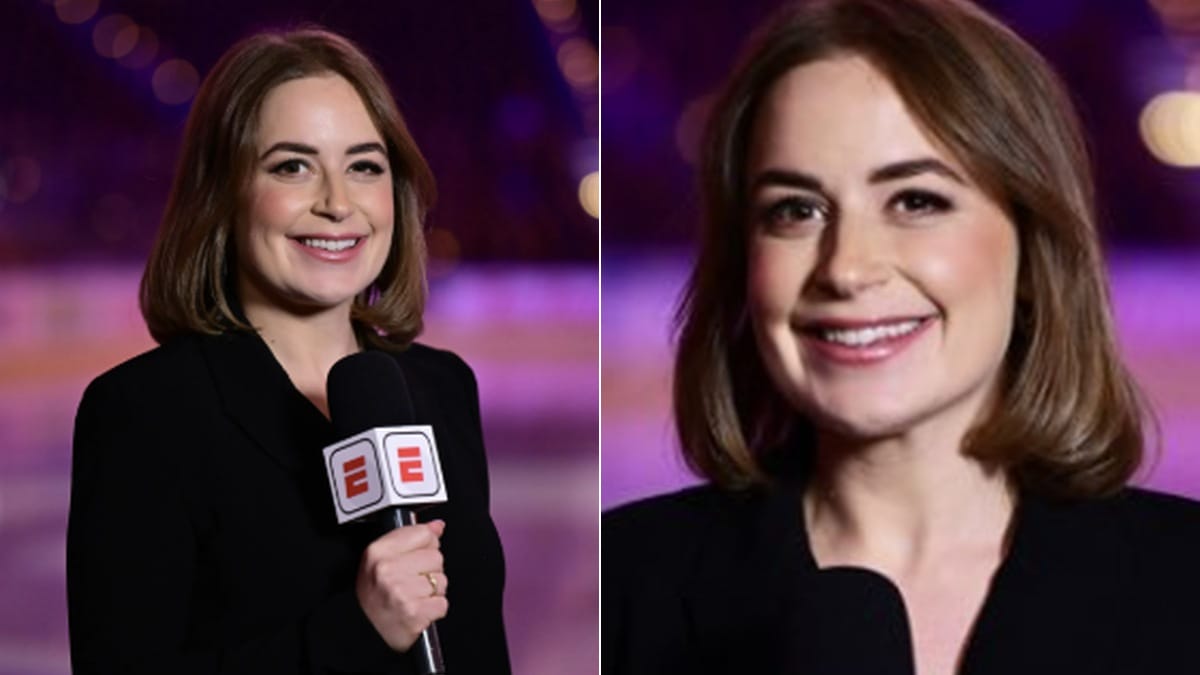
Emily Kaplan is ESPN’s NHL insider — the network’s lead breaking-news reporter for hockey, the role ESPN fills with Adam Schefter for the NFL and Jeff Passan for baseball. ESPN moved Kaplan into the job in September 2025 after four seasons as its lead rink-side reporter. Kaplan joined ESPN in 2017 as a national NHL writer, two months after the network’s layoffs had wiped out its entire hockey desk.
| Full name | Emily Kaplan |
| From | Montclair, New Jersey; based in Chicago |
| Born | 1991 |
| Role now | NHL insider, ESPN |
| At ESPN since | June 2017 |
| Previously | Sports Illustrated and The MMQB, 2013–2017 |
| Known for | ESPN’s first designated NHL insider; thanking players in their native language |
| Education | Penn State University, journalism, 2013 |
Who is Emily Kaplan?
Emily Kaplan is an American reporter who covers the NHL for ESPN. Kaplan grew up in Montclair, New Jersey, watching Rangers games with her father Dave Kaplan, the Sunday sports editor at the New York Daily News. Kaplan went to Penn State for its sports journalism programme, stringing for the Associated Press, the Philadelphia Inquirer and the Boston Globe while still a student, and graduated in 2013. Kaplan has lived in Chicago since 2016.
ESPN confirmed the role on 22 September 2026, naming her NHL insider and reporter in its 2026-27 commentator lineup and putting her on the opening-night crew with Sean McDonough and Ray Ferraro.
How old is Emily Kaplan?
Emily Kaplan was born in 1991, making her 35. Kaplan has not published an exact date of birth and the dates circulating online disagree with one another, so the year is as far as this goes.
Is Emily Kaplan married? Does she have children?
Nothing about Emily Kaplan’s relationship status is public. Kaplan keeps her personal life out of her work and has never discussed a partner, a marriage or children in any interview or profile. The only family member Kaplan has spoken about publicly is her father. Sites answering this question are guessing, and they contradict each other.
Is Emily Kaplan related to David Kaplan?
No. Emily Kaplan is not the daughter of David Kaplan, the Chicago radio and
television host, and David Kaplan has said so himself — replying to one of her
posts in June 2022, Kaplan wrote: “Great work Emily! (No, she is not my
daughter)!” The confusion has a real root, though. Emily Kaplan’s father is
also a sports journalist named Dave Kaplan, the Sunday sports editor at the New
York Daily News. And Emily Kaplan has lived in Chicago since 2016 — the city
where David Kaplan has broadcast for three decades, on WGN Radio, Comcast
SportsNet and ESPN 1000, covering the Cubs, White Sox and Bears. Two sports
journalists named Dave Kaplan, and only one of them is her father.
How does Emily Kaplan do interviews?
Emily Kaplan has described the method in three words: open, lean and neutral. Kaplan asks broad questions — “What do you make of the first period?” — rather than leading ones, on the theory that a player says more when he has not been told what answer is wanted. Kaplan’s stated on-air fear is talking over live action, because hockey is “the fastest sport with the least amount of breaks.” And Kaplan closes interviews by saying thank you in the player’s native language, which in a league drawing from a dozen countries has become the thing she is best known for.